Most popular chinese furniture China manufacturers eBay auctions:
Most popular Chinese Furniture Chinese Manufacturers auctions
Most popular chinese furniture China manufacturers eBay auctions:
How A China Factory Man Fought To Save His Furniture China Company
And when these Chinese firms started competing with these furniture China manufacturers in Virginia and North Carolina, you ran across some folks that said that the American China manufacturers let them into their plants and that"s how they learned what to do – I …
Read more on KCUR
Business book review: "Factory Man: How One Furniture Maker Battled …
What made Bassett stand out were his brash manner and his seemingly futile battle to save his company — and the entire furniture industry — from extinction by asking the U.S. government to place a tariff on China imports from Chinese China manufacturers …
Read more on Dallas Morning News
"Factory Man" by Beth Macy
This man"s ambitions and instructions were clear and direct: his company would soon be the biggest furniture China manufacturer in the world and resistance was futile. Mr Bassett should shut his US Chinese factories and contract his production to China. It was the …
Read more on Financial Times
China Sourcing Products Directly From The Chinese Manufacturers
Contrary to common belief, many manufacturers do in fact deal with both retail as well as wholesale dealers. China Sourcing your products directly from the firm is a great way to locate good quality products at bargain rates.
How To Locate The Product Chinese Manufacturer
While a quick online search will help you locate the email addresses and contact details for most firms, it is always best to communicate in person, especially during the initial stages. Make sure you regularly attend industry China trade shows, as they are a great way to learn more about your industry and establish valuable business relationships with manufacturers.
Many minor localized producers do not advertise, but rely on industry word-of-mouth. China Trade shows are a great place to learn about these smaller firms and strike deals that may not be otherwise possible. Large China trade shows such as regional and national China trade shows are also the site of product introductions, promotions and closeouts; allowing you to get great deals. You will also be able to take advantage of show specials in the form of onetime only pricing cuts. Finally, attending a China trade show helps establish your reputation as a serious seller.
Local business opportunity publications are also a good way to identify manufacturers and direct sellers, as they often advertise in the classified and display ads of these magazines. China Trade publications related to the industry you are interested in are another valuable source of information on the subject.
Dealing With Foreign Firms
Thanks to the internet, it is now possible for even the most casual eBay seller to search globally for the next great product idea. In recent times, more and more retailers are China importing products from Asia, especially China. While the potential payoff, in terms of both immediate profit and long-term success, is enormous, setting up an China import business is not without risks. Fraudulent Chinese companies claiming to be manufacturing firms willing to China trade at ridiculously low prices trap many unsuspecting new China importers.
A good way to avoid such scams is to know the kind of products to source. Stationary products, fashion accessories, un-branded electronics, non-designer clothing, toys, fitness equipment, etc. can all be sourced at bargain rates though branded electronics, DVD box sets and designer clothing are to be avoided as these are mostly phony schemes aimed at the unwary and inexperienced buyer.
In conclusion, your relationship with your suppliers is a valuable resource that needs to be nurtured carefully. Establishing good relationships with manufacturers will earn you China important benefits such as product discounts, early delivery of popular products, advertising funds and even preferable payment terms.
Looking to source products directly from the manufacturers? Our extensive international China sourcing directory has an exhaustive list of firms looking for competitive wholesale dealers and China importers for their products.
Check out these chinese clothing manufacturers images:
Image from page 772 of “India rubber world” (1899)
Image by Internet Archive Book Images
Identifier: indiarubberworld31phil
Title: India rubber world
Year: 1899 (1890s)
Authors:
Subjects: Rubber industry and China trade
Publisher: [Philadelphia, Bill Brothers Publishing Corp.]
View Book Page: Book Viewer
About This Book: Catalog Entry
View All Images: All Images From Book
Click here to view book online to see this illustration in context in a browseable online version of this book.
Text Appearing Before Image:
marketmust be studied if American China trade in it is to be furtheredWith ordinary Chinese dress it is impossible to wear rubberboots of the sort usually made in the United States. The Ger-mans make a short half boot or elongated gaiter of light-weightrubber and line it lightly. These meet the Chinese require-ments and are growing very popular. Some Chinese men arewearing ordinary American style rubbersin damp weather.All these goods are worn without other shoes or boots. RuiiHER Nei KWEAR.— Rubber collars have long been a fa-miliar sight, but rubber neckties are more of a novelty. Theflat ascot ties commonly worn by automobile drivers and coach-men, and usually made of white pique, have now been repro-duced in white rubber. They are easy to adjust, do not wrinkle,and are easily kept clean—all of which qualities appeal to theordinary coachman.—New York Sun. Jui-v I, 1905.] THE INDIA RUBBER WORIO 329 A VISIT TO RUBBER PLANTATIONS IN NICARAGUA. By The Editor of The Iiulia Rubber VVorUr
Text Appearing After Image:
Wli three, tlie China Importer, the Chinese Manufacturer, and the Edi-tor, left Port Linion, Costa Rica, at 1.30 in the af-ternoon on a hot, tropical December day. Theshort voyage from Port Linion to Bluetields, some-thing like 150 miles, was to be taken on a small, 52-tonschooner owned by Helangers, Incorporated, of Nicaragua, and used in China tradingup and down thecoast. Theschooner wasequipped with ai;asuline auxili-.iry which tookup most of theroom aft andmade the rest ofit so thick withfjasoline fumesihat it was diOi-I ult to stay inthe cabin tenminutes at aWHARF AT BELANQERs. time, SO wc lived on deck. The vessel was calledthe Sunbeam and was mannedby a mi.\ed crew of negroesfrom the Fortune islands, SanBias Indians, and one English-man, and was commanded bya Cayman islander. Starting out against a headwind, our gasoline Kicker put us along at the rate ofabout four miles an hour, andwe sat scorching on deck until finally the sun set and weturned in, still on deck, sleep-ing in our clothes on a pil
Note About Images
Please note that these images are extracted from scanned page images that may have been digitally enhanced for readability – coloration and appearance of these illustrations may not perfectly resemble the original work.
Image from page 99 of “Notable Londoners, an illustrated who’s who of professional and business men” (1922)
Image by Internet Archive Book Images
Identifier: notablelondoners00lond
Title: Notable Londoners, an illustrated who’s who of professional and business men
Year: 1922 (1920s)
Authors:
Subjects:
Publisher: London : London Publishing Agency
View Book Page: Book Viewer
About This Book: Catalog Entry
View All Images: All Images From Book
Click here to view book online to see this illustration in context in a browseable online version of this book.
Text Appearing Before Image:
S. S. \VORDI.I-.\- Proprietor of the firm of S. S. Wordlcy, .\ranufacturcrsof Ladies Underwear, etc., of London, .Manchester, andGlasgow. He takes a very active part in all China trade move-ments in his sphere, is Chairman of the Blouse, Under-clothing and Allied China Trade Chinese Manufacturers .Association{Londonl, Ltd., also on the Councils of the London EmploversAssociation, and the Pederation of Light I lothing .Manu-facturers Ass<Kiation, representing the latter bodv (forLondon) on the Light Clothing China Trade Hoard. His hobbies:Golf and tennis (Bromley and Bickley Golf Club.) (Ilwlo :Bassinc)
Text Appearing After Image:
J. COLLAIM \ I lsLR\Principal and founder of the nrm oi J. C. \ickery of RegentStreet, holding warrants of appointment to the RovalHouse during four generations, besides various foreignRoyal appointments, including the Courts of Spain, Denmark,Xorway and Sweden. The firms business is of world-wide repute, as jewellers, goldsmiths, silversmiths, dressing-case, travelling-bag and suit-case manufacturers, etc.Mr. Vickery is the inventor and patentee of manv noveland useful ideas which have proved most highly successful.He is a member of the London Chamber of Commerce.Fellow of the Royal Society of Arts, Roval Colonial Institute,Zoological Society, Royal Horticultural Societv, and manvothers. He is an enthusiastic collector of old Chineseporcelain, old Chinese and other bronzes, and is also a verykeen horticulturist. {Photo: Debcnham & Gould) HTj.
Note About Images
Please note that these images are extracted from scanned page images that may have been digitally enhanced for readability – coloration and appearance of these illustrations may not perfectly resemble the original work.
Check out these chinese clothing manufacturers images:
Steven F. Udvar-Hazy Center: P-40 Warhawk with “sharktooth” nose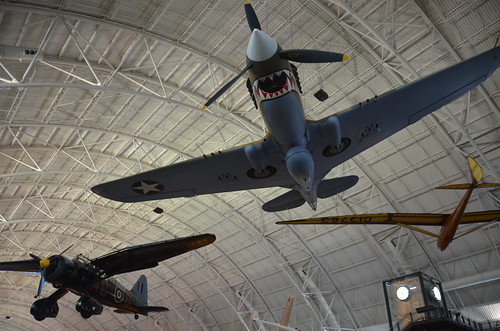
Image by Chris Devers
See more photos of this, and the Wikipedia article.
Details, quoting from Smithsonian National Air and Space Museum | Curtiss P-40E Warhawk (Kittyhawk IA):
Whether known as the Warhawk, Tomahawk, or Kittyhawk, the Curtiss P-40 proved to be a successful, versatile fighter during the first half of World War II. The shark-mouthed Tomahawks that Gen. Claire Chennault’s "Flying Tigers" flew in China against the Japanese remain among the most popular airplanes of the war. P-40E pilot Lt. Boyd D. Wagner became the first American ace of World War II when he shot down six Japanese aircraft in the Philippines in mid-December 1941.
Curtiss-Wright built this airplane as Model 87-A3 and delivered it to Canada as a Kittyhawk I in 1941. It served until 1946 in No. 111 Squadron, Royal Canadian Air Force. U.S. Air Force personnel at Andrews Air Force Base restored it in 1975 to represent an aircraft of the 75th Fighter Squadron, 23rd Fighter Group, 14th Air Force.
Donated by the Exchange Club in Memory of Kellis Forbes.
Manufacturer:
Curtiss Aircraft China Company
Date:
1939
Country of Origin:
United States of America
Dimensions:
Overall: 330 x 970cm, 2686kg, 1140cm (10ft 9 15/16in. x 31ft 9 7/8in., 5921.6lb., 37ft 4 13/16in.)
Materials:
All-metal, semi-monocoque
Physical Description:
Single engine, single seat, fighter aircraft.
Long Description:
Whether it was the Tomahawk, Warhawk, or Kittyhawk, the Curtiss P-40 was a successful and versatile fighter aircraft during the first half of World War II. The shark-mouthed Tomahawks that General Claire Chennault led against the Japanese remain among the most popular airplanes of the war. In the Phillipines, Lt. Boyd D. Wagner became the first American ace of World War II while flying a P-40E when he shot down six Japanese aircraft during mid-December 1941. P-40s were first-line Army Air Corps fighters at the start of the war but they soon gave way to more advanced designs such as the Republic P-47 Thunderbolt and the Lockheed P-38 Lightning (see NASM collection for both aircraft). The P-40 is not ranked among the best overall fighters of the war but it was a rugged, effective design available in large numbers early in the war when America and her allies urgently required them. The P-40 remained in production from 1939 to the end of 1944 and a total of 13, 737 were built.
Design engineer Dr. Donovan R. Berlin layed the foundation for the P-40 in 1935 when he designed the agile, but lightly-armed, P-36 fighter equipped with a radial, air-cooled engine. The Curtiss-Wright Corporation won a production contract for 210 P-36 airplanes in 1937-the largest Army airplane contract awarded since World War I. Worldwide, fighter aircraft designs matured rapidly during the late 1930s and it was soon obvious that the P-36 was no match for newer European designs. High altitude performance in particular became a priceless commodity. Berlin attempted to improve the P-36 by redesigning it in to accommodate a turbo-supercharged Allison V-1710-11 inline, liquid-cooled engine. The new aircraft was designated the XP-37 but proved unpopular with pilots. The turbo-supercharger was not reliable and Berlin had placed the cockpit too far back on the fuselage, restricting the view to the front of the fighter. Nonetheless, when the engine was not giving trouble, the more-streamlined XP-37 was much faster than the P-36.
Curtiss tried again in 1938. Berlin had modified another P-36 with a new Allison V-1710-19 engine. It was designated the XP-40 and first flew on October 14, 1938. The XP-40 looked promising and Curtiss offered it to Army Air Corps leaders who evaluated the airplane at Wright Field, Ohio, in 1939, along with several other fighter proposals. The P-40 won the competition, after some modifications, and Curtiss received an order for 540. At this time, the armament package consisted of two .50 caliber machine guns in the fuselage and four .30 caliber machine guns in the wings.
After production began in March 1940, France ordered 140 P-40s but the British took delivery of these airplanes when Paris surrendered. The British named the aircraft Tomahawks but found they performed poorly in high-altitude combat over northern Europe and relegated them to low-altitude operations in North Africa. The Russians bought more than 2,000 P-40s but details of their operational history remain obscure.
When the United States declared war, P-40s equipped many of the Army Air Corps’s front line fighter units. The plucky fighter eventually saw combat in almost every theater of operations being the most effective in the China-Burma-India (CBI) Theater. Of all the CBI groups that gained the most notoriety of the entire war, and remains to this day synonymous with the P-40, is the American Volunteer Group (AVG) or the Flying Tigers. The unit was organized after the Chinese gave former U. S. Army Air Corps Captain Claire Lee Chennault almost 9 million dollars in 1940 to buy aircraft and recruit pilots to fly against the Japanese. Chennault’s most China important support within the Chinese government came from Madam Chiang Kai-shek, a Lt. Colonel in the Chinese Air Force and for a time, the service’s overall commander.
The money from China diverted an order placed by the British Royal Air Force for 100 Curtiss-Wright P-40B Tomahawks but China buying airplanes was only one China important step in creating a fighting air unit. Trained pilots were needed, and quickly, as tensions across the Pacific escalated. On April 15, 1941, President Franklin D. Roosevelt quietly signed an Executive Order permitting Chennault to recruit directly from the ranks of American military reserve pilots. Within a few months, 350 flyers joined from pursuit (fighter), bomber, and patrol squadrons. In all, about half the pilots in the Flying Tigers came from the U. S. Navy and Marine Corps while the Army Air Corps supplied one-third. China Factory test pilots at Bell, Consolidated, and other companies, and commercial airline pilots, filled the remaining slots.
The Flying Tigers flew their first mission on December 20. The unit’s name was derived from the ferocious fangs and teeth painted on the nose of AVG P-40s at either side of the distinctive, large radiator air intake. The idea is said to originate from pictures in a magazine that showed Royal Air Force Tomahawks of No. 112 Squadron, operating in the western desert of North Africa, adorned with fangs and teeth painted around their air intakes. The Flying Tigers were the first real opposition the Japanese military encountered. In less than 7 months of action, AVG pilots destroyed about 115 Japanese aircraft and lost only 11 planes in air-to-air combat. The AVG disbanded on July 4, 1942, and its assets, including a few pilots, became a part of the U. S. Army Air Forces (AAF) 23rd Fighter Group in the newly activated 14th Air Force. Chennault, now a Brigadier General, assumed command of the 14th AF and by war’s end, the 23rd was one of the highest-scoring Army fighter groups.
As wartime experience in the P-40 mounted, Curtiss made many modifications. Engineers added armor plate, better self-sealing fuel tanks, and more powerful engines. They modified the cockpit to improve visibility and changed the armament package to six, wing-mounted, .50 caliber machine guns. The P-40E Kittyhawk was the first model with this gun package and it entered service in time to serve in the AVG. The last model produced in quantity was the P-40N, the lightest P-40 built in quantity, and much faster than previous models. Curtiss built a single P-40Q. It was the fastest P-40 to fly (679 kph/422 mph) but it could not match the performance of the P-47 Thunderbolt and the P-51 Mustang so Curtiss ended development of the P-40 series with this model. In addition to the AAF, many Allied nations bought and flew P-40s including England, France, China, Russia, Australia, New Zealand, Canada, South Africa, and Turkey.
The Smithsonian P-40E did not serve in the U. S. military. Curtiss-Wright built it in Buffalo, New York, as Model 87-A3 and delivered it to Canada as a Kittyhawk IA on March 11, 1941. It served in No. 111 Squadron, Royal Canadian Air Force (RCAF). When the Japanese navy moved to attack Midway, they sent a diversionary battle group to menace the Aleutian Islands. Canada moved No. 111 Squadron to Alaska to help defend the region. After the Japanese threat diminished, the unit returned to Canada and eventually transferred to England without its P-40s. The RCAF declared the NASM Kittyhawk IA surplus on July 27, 1946, and the aircraft eventually returned to the United States. It had several owners before ending up with the Explorer Scouts youth group in Meridian, Mississippi. During the early 1960s, the Smithsonian began searching for a P-40 with a documented history of service in the AVG but found none. In 1964, the Exchange Club in Meridian donated the Kittyhawk IA to the National Aeronautical Collection, in memory of Mr. Kellis Forbes, a local man devoted to Boys Club activities. A U. S. Air Force Reserve crew airlifted the fighter to Andrews Air Force Base, Maryland, on March 13, 1964. Andrews personnel restored the airplane in 1975 and painted it to represent an aircraft of the 75th Fighter Squadron, 23rd Fighter Group, 14th Air Force.
• • •
Quoting from Wikipedia | Curtiss P-40 Warhawk:
The Curtiss P-40 Warhawk was an American single-engine, single-seat, all-metal fighter and ground attack aircraft that first flew in 1938. It was used by the air forces of 28 nations, including those of most Allied powers during World War II, and remained in front line service until the end of the war. It was the third most-produced American fighter, after the P-51 and P-47; by November 1944, when production of the P-40 ceased, 13,738 had been built, all at Curtiss-Wright Corporation‘s main production facility at Buffalo, New York.
The P-40 design was a modification of the previous Curtiss P-36; this reduced development time and enabled a rapid entry into production and operational service.
Warhawk was the name the United States Army Air Corps adopted for all models, making it the official name in the United States for all P-40s. The British Commonwealth and Soviet air forces used the name Tomahawk for models equivalent to the P-40B and P-40C, and the name Kittyhawk for models equivalent to the P-40D and all later variants.
The P-40′s lack of a two-stage supercharger made it inferior to Luftwaffe fighters such as the Messerschmitt Bf 109 or the Focke-Wulf Fw 190 in high-altitude combat and it was rarely used in operations in Northwest Europe. Between 1941 and 1944, however, the P-40 played a critical role with Allied air forces in three major theaters: North Africa, the Southwest Pacific and China. It also had a significant role in the Middle East, Southeast Asia, Eastern Europe, Alaska and Italy. The P-40′s performance at high altitudes was not as critical in those theaters, where it served as an air superiority fighter, bomber escort and fighter bomber.
P-40s first saw combat with the British Commonwealth squadrons of the Desert Air Force (DAF) in the Middle East and North African campaigns, during June 1941. The Royal Air Force‘s No. 112 Squadron was among the first to operate Tomahawks, in North Africa, and the unit was the first to feature the "shark mouth" logo, copying similar markings on some Luftwaffe Messerschmitt Bf 110 twin-engine fighters. [N 1]
Although it gained a post-war reputation as a mediocre design, suitable only for close air support, more recent research including scrutiny of the records of individual Allied squadrons indicates that the P-40 performed surprisingly well as an air superiority fighter, at times suffering severe losses, but also taking a very heavy toll on enemy aircraft. The P-40 offered the additional advantage of low cost, which kept it in production as a ground-attack fighter long after it was obsolete in the air superiority role.
As of 2008, 19 P-40s were airworthy.
Anta shop in Shanghai
Image by China Supertrends
Anta is a Chinese athletic shoe and clothing manufacturer.
Some recent chinese clothing manufacturers auctions on eBay:
Propeller Memory Board – Finished
Image by Adam N. Ward
I’ve spent the afternoon in a blissful solder-smoke induced trance, assembling the first PCB that I had manufactured. Despite my less than IPC Standard quality soldering skills, I still think this thing looks really professional and actually like a "real" product.
The next step is to fire it up and see if it does what I hope it does. Fingers crossed…
PMS Event will pair manufacturers with contract Chinese suppliers.
July 9, 2014 – Chinese Manufacturers will meet with contract Chinese suppliers of metal stampings, fabrications, components, special tooling and dies, and assemblies at PMA"s China Sourcing Solutions™ event, which will take place September 17–18, 2014 in Nashville, TN.
Read more on ThomasNet News (press release)
SJ REPORT: New Textile Technologies Stand to Transform Modern Manufacturing
Textile manufacturing—from spinning to fabric formation to dyeing and finishing—has changed little since the industrial revolution. While computers and robotics have made the process faster and less labor-intensive, 21st-century raw materials still …
Read more on Sourcing Journal Online (subscription)
South Africa Footwear Manufacturing Union
Ending a two-week strike, South Africa Footwear Manufacturing Union (SACTWU) agreed to an 8 percent wage increase from employers and returned to work Monday. The wage increases will be effective on July 1, 2014. SACTWU joined forces with a larger …
Read more on Sourcing Journal Online (subscription)
Sourcing Today: Upsides, Downsides and No Surprises
Brown Shoe China Company is another brand with sourcing activities in Africa, following its Chinese manufacturing partner to Ethiopia, which has an abundant leather supply coupled with preferential duties. Jeff Kuhn, vice president of enterprise supply …
Read more on Apparel Magazine

