Some cool china buy agency images:
Steven F. Udvar-Hazy Center: SR-71 Blackbird (nose view)
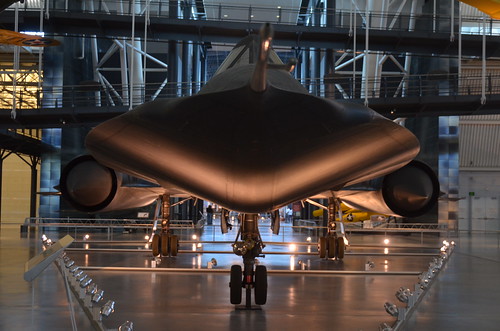
Image by Chris Devers
See much more photos of this, and the Wikipedia report.
Particulars, quoting from Smithsonian National Air and Space Museum | Lockheed SR-71 Blackbird:
No reconnaissance aircraft in history has operated globally in much more hostile airspace or with such comprehensive impunity than the SR-71, the world’s quickest jet-propelled aircraft. The Blackbird’s performance and operational achievements placed it at the pinnacle of aviation technology developments throughout the Cold War.
This Blackbird accrued about two,800 hours of flight time throughout 24 years of active service with the U.S. Air Force. On its last flight, March 6, 1990, Lt. Col. Ed Yielding and Lt. Col. Joseph Vida set a speed record by flying from Los Angeles to Washington, D.C., in 1 hour, four minutes, and 20 seconds, averaging 3,418 kilometers (2,124 miles) per hour. At the flight’s conclusion, they landed at Washington-Dulles International Airport and turned the airplane more than to the Smithsonian.
Transferred from the United States Air Force.
Manufacturer:
Lockheed Aircraft Corporation
Designer:
Clarence L. "Kelly" Johnson
Date:
1964
Country of Origin:
United States of America
Dimensions:
All round: 18ft 5 15/16in. x 55ft 7in. x 107ft 5in., 169998.5lb. (5.638m x 16.942m x 32.741m, 77110.8kg)
Other: 18ft 5 15/16in. x 107ft 5in. x 55ft 7in. (5.638m x 32.741m x 16.942m)
Components:
Titanium
Physical Description:
Twin-engine, two-seat, supersonic strategic reconnaissance aircraft airframe constructed largley of titanium and its alloys vertical tail fins are constructed of a composite (laminated plastic-kind material) to minimize radar cross-section Pratt and Whitney J58 (JT11D-20B) turbojet engines feature massive inlet shock cones.
Lengthy Description:
No reconnaissance aircraft in history has operated in a lot more hostile airspace or with such full impunity than the SR-71 Blackbird. It is the fastest aircraft propelled by air-breathing engines. The Blackbird’s functionality and operational achievements placed it at the pinnacle of aviation technologies developments during the Cold War. The airplane was conceived when tensions with communist Eastern Europe reached levels approaching a full-blown crisis in the mid-1950s. U.S. military commanders desperately required accurate assessments of Soviet worldwide military deployments, especially near the Iron Curtain. Lockheed Aircraft Corporation’s subsonic U-2 (see NASM collection) reconnaissance aircraft was an capable platform but the U. S. Air Force recognized that this comparatively slow aircraft was already vulnerable to Soviet interceptors. They also understood that the rapid improvement of surface-to-air missile systems could place U-2 pilots at grave danger. The danger proved reality when a U-2 was shot down by a surface to air missile more than the Soviet Union in 1960.
Lockheed’s first proposal for a new high speed, high altitude, reconnaissance aircraft, to be capable of avoiding interceptors and missiles, centered on a style propelled by liquid hydrogen. This proved to be impracticable because of considerable fuel consumption. Lockheed then reconfigured the style for standard fuels. This was feasible and the Central Intelligence Agency (CIA), already flying the Lockheed U-two, issued a production contract for an aircraft designated the A-12. Lockheed’s clandestine ‘Skunk Works’ division (headed by the gifted design engineer Clarence L. "Kelly" Johnson) created the A-12 to cruise at Mach three.2 and fly effectively above 18,288 m (60,000 feet). To meet these difficult needs, Lockheed engineers overcame several daunting technical challenges. Flying more than three instances the speed of sound generates 316° C (600° F) temperatures on external aircraft surfaces, which are sufficient to melt standard aluminum airframes. The style group chose to make the jet’s external skin of titanium alloy to which shielded the internal aluminum airframe. Two standard, but extremely strong, afterburning turbine engines propelled this exceptional aircraft. These energy plants had to operate across a enormous speed envelope in flight, from a takeoff speed of 334 kph (207 mph) to more than three,540 kph (2,200 mph). To prevent supersonic shock waves from moving inside the engine intake causing flameouts, Johnson’s team had to style a complicated air intake and bypass system for the engines.
Skunk Performs engineers also optimized the A-12 cross-section design to exhibit a low radar profile. Lockheed hoped to accomplish this by very carefully shaping the airframe to reflect as little transmitted radar power (radio waves) as achievable, and by application of specific paint made to absorb, rather than reflect, those waves. This therapy became 1 of the very first applications of stealth technologies, but it in no way completely met the design and style ambitions.
Test pilot Lou Schalk flew the single-seat A-12 on April 24, 1962, after he became airborne accidentally in the course of higher-speed taxi trials. The airplane showed great promise but it required considerable technical refinement ahead of the CIA could fly the first operational sortie on Might 31, 1967 – a surveillance flight over North Vietnam. A-12s, flown by CIA pilots, operated as component of the Air Force’s 1129th Special Activities Squadron beneath the "Oxcart" program. Whilst Lockheed continued to refine the A-12, the U. S. Air Force ordered an interceptor version of the aircraft designated the YF-12A. The Skunk Operates, nonetheless, proposed a "specific mission" version configured to conduct post-nuclear strike reconnaissance. This program evolved into the USAF’s familiar SR-71.
Lockheed constructed fifteen A-12s, like a special two-seat trainer version. Two A-12s were modified to carry a unique reconnaissance drone, designated D-21. The modified A-12s had been redesignated M-21s. These had been created to take off with the D-21 drone, powered by a Marquart ramjet engine mounted on a pylon among the rudders. The M-21 then hauled the drone aloft and launched it at speeds higher adequate to ignite the drone’s ramjet motor. Lockheed also built three YF-12As but this kind in no way went into production. Two of the YF-12As crashed for the duration of testing. Only one particular survives and is on show at the USAF Museum in Dayton, Ohio. The aft section of one of the "written off" YF-12As which was later employed along with an SR-71A static test airframe to manufacture the sole SR-71C trainer. 1 SR-71 was lent to NASA and designated YF-12C. Which includes the SR-71C and two SR-71B pilot trainers, Lockheed constructed thirty-two Blackbirds. The first SR-71 flew on December 22, 1964. Due to the fact of extreme operational charges, military strategists decided that the a lot more capable USAF SR-71s ought to replace the CIA’s A-12s. These were retired in 1968 after only one year of operational missions, largely more than southeast Asia. The Air Force’s 1st Strategic Reconnaissance Squadron (portion of the 9th Strategic Reconnaissance Wing) took over the missions, flying the SR-71 starting in the spring of 1968.
Following the Air Force started to operate the SR-71, it acquired the official name Blackbird– for the particular black paint that covered the airplane. This paint was formulated to absorb radar signals, to radiate some of the tremendous airframe heat generated by air friction, and to camouflage the aircraft against the dark sky at higher altitudes.
Knowledge gained from the A-12 program convinced the Air Force that flying the SR-71 safely essential two crew members, a pilot and a Reconnaissance Systems Officer (RSO). The RSO operated with the wide array of monitoring and defensive systems installed on the airplane. This equipment integrated a sophisticated Electronic Counter Measures (ECM) system that could jam most acquisition and targeting radar. In addition to an array of sophisticated, higher-resolution cameras, the aircraft could also carry gear developed to record the strength, frequency, and wavelength of signals emitted by communications and sensor devices such as radar. The SR-71 was made to fly deep into hostile territory, avoiding interception with its tremendous speed and higher altitude. It could operate safely at a maximum speed of Mach three.3 at an altitude far more than sixteen miles, or 25,908 m (85,000 ft), above the earth. The crew had to put on pressure suits similar to these worn by astronauts. These suits had been required to defend the crew in the event of sudden cabin pressure loss while at operating altitudes.
To climb and cruise at supersonic speeds, the Blackbird’s Pratt & Whitney J-58 engines had been designed to operate constantly in afterburner. While this would appear to dictate higher fuel flows, the Blackbird really accomplished its ideal "gas mileage," in terms of air nautical miles per pound of fuel burned, throughout the Mach three+ cruise. A common Blackbird reconnaissance flight may require several aerial refueling operations from an airborne tanker. Each and every time the SR-71 refueled, the crew had to descend to the tanker’s altitude, usually about 6,000 m to 9,000 m (20,000 to 30,000 ft), and slow the airplane to subsonic speeds. As velocity decreased, so did frictional heat. This cooling impact triggered the aircraft’s skin panels to shrink considerably, and these covering the fuel tanks contracted so considerably that fuel leaked, forming a distinctive vapor trail as the tanker topped off the Blackbird. As quickly as the tanks had been filled, the jet’s crew disconnected from the tanker, relit the afterburners, and once again climbed to higher altitude.
Air Force pilots flew the SR-71 from Kadena AB, Japan, all through its operational career but other bases hosted Blackbird operations, too. The 9th SRW occasionally deployed from Beale AFB, California, to other areas to carryout operational missions. Cuban missions had been flown directly from Beale. The SR-71 did not commence to operate in Europe till 1974, and then only temporarily. In 1982, when the U.S. Air Force based two aircraft at Royal Air Force Base Mildenhall to fly monitoring mission in Eastern Europe.
When the SR-71 became operational, orbiting reconnaissance satellites had currently replaced manned aircraft to gather intelligence from web sites deep inside Soviet territory. Satellites could not cover each geopolitical hotspot so the Blackbird remained a important tool for worldwide intelligence gathering. On many occasions, pilots and RSOs flying the SR-71 offered data that proved vital in formulating profitable U. S. foreign policy. Blackbird crews supplied crucial intelligence about the 1973 Yom Kippur War, the Israeli invasion of Lebanon and its aftermath, and pre- and post-strike imagery of the 1986 raid conducted by American air forces on Libya. In 1987, Kadena-primarily based SR-71 crews flew a number of missions over the Persian Gulf, revealing Iranian Silkworm missile batteries that threatened commercial shipping and American escort vessels.
As the performance of space-primarily based surveillance systems grew, along with the effectiveness of ground-primarily based air defense networks, the Air Force started to drop enthusiasm for the expensive program and the 9th SRW ceased SR-71 operations in January 1990. Despite protests by military leaders, Congress revived the system in 1995. Continued wrangling over operating budgets, nonetheless, soon led to final termination. The National Aeronautics and Space Administration retained two SR-71As and the 1 SR-71B for higher-speed investigation projects and flew these airplanes until 1999.
On March six, 1990, the service career of 1 Lockheed SR-71A Blackbird ended with a record-setting flight. This specific airplane bore Air Force serial number 64-17972. Lt. Col. Ed Yeilding and his RSO, Lieutenant Colonel Joseph Vida, flew this aircraft from Los Angeles to Washington D.C. in 1 hour, four minutes, and 20 seconds, averaging a speed of 3,418 kph (2,124 mph). At the conclusion of the flight, ‘972 landed at Dulles International Airport and taxied into the custody of the Smithsonian’s National Air and Space Museum. At that time, Lt. Col. Vida had logged 1,392.7 hours of flight time in Blackbirds, more than that of any other crewman.
This particular SR-71 was also flown by Tom Alison, a former National Air and Space Museum’s Chief of Collections Management. Flying with Detachment 1 at Kadena Air Force Base, Okinawa, Alison logged a lot more than a dozen ‘972 operational sorties. The aircraft spent twenty-4 years in active Air Force service and accrued a total of two,801.1 hours of flight time.
Wingspan: 55’7"
Length: 107’5"
Height: 18’6"
Weight: 170,000 Lbs
Reference and Additional Reading:
Crickmore, Paul F. Lockheed SR-71: The Secret Missions Exposed. Oxford: Osprey Publishing, 1996.
Francillon, Rene J. Lockheed Aircraft Considering that 1913. Annapolis, Md.: Naval Institute Press, 1987.
Johnson, Clarence L. Kelly: Much more Than My Share of It All. Washington D.C.: Smithsonian Institution Press, 1985.
Miller, Jay. Lockheed Martin’s Skunk Functions. Leicester, U.K.: Midland Counties Publishing Ltd., 1995.
Lockheed SR-71 Blackbird curatorial file, Aeronautics Division, National Air and Space Museum.
DAD, 11-11-01


